

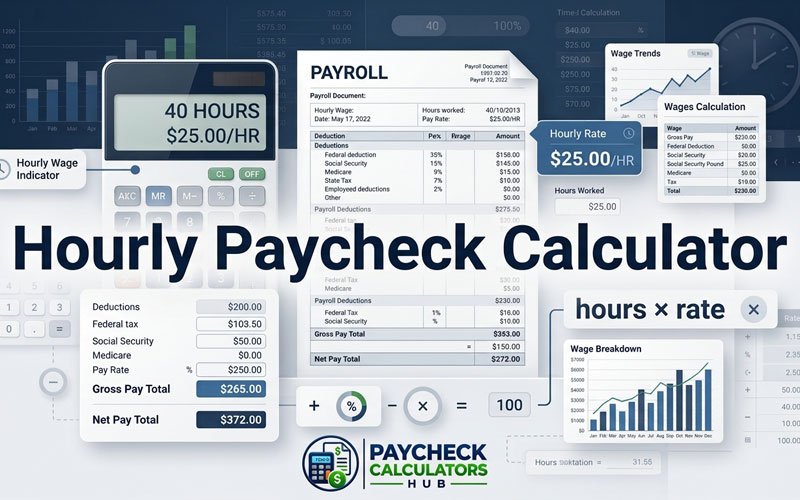
An hourly paycheck calculator determines your exact net pay by starting with your gross wages—calculated via hours worked multiplied by your hourly rate—and systematically subtracting federal income tax, state income tax, FICA contributions (6.2% Social Security and 1.45% Medicare), and pre-tax deductions like 401(k) and HSA contributions under 2026 tax laws.
Hourly Paycheck Calculator
Calculate your estimated 2026 take-home pay, federal & state tax withholdings.
Decoding the 2026 Hourly Paycheck: A Financial Data Journalist's Masterclass
- Gross hourly earnings must account for overtime premiums under the Fair Labor Standards Act, requiring time-and-a-half compensation for hours worked beyond 40 in a single workweek.
- Federal income tax withholding depends heavily on the accuracy of your Form W-4, which eliminated traditional personal exemptions in favor of dependent tax credits and simplified filing statuses.
- FICA taxes apply a flat 7.65% mandatory levy up to the Social Security wage base limit, alongside an additional 0.9% Medicare surtax for high earners exceeding specified wage thresholds.
- State and local tax obligations vary wildly across jurisdictions, ranging from zero-income-tax states like Texas and Florida to progressive tax brackets topping 13% in California.
- Strategic utilization of pre-tax accounts such as traditional 401(k) plans and Health Savings Accounts directly lowers your adjusted gross income, reducing overall tax liability dollar-for-dollar.
For millions of American hourly workers, the weekly or bi-weekly pay stub remains a document of profound mystery. Gross earnings bear little resemblance to the cash deposited into checking accounts. Behind that disparity lies a complex architecture of federal statutory tax rates, state-level legislative adjustments, municipal assessments, and employee-elected benefit deductions. As wage structures evolve across the United States, utilizing an accurate hourly paycheck calculator becomes an essential financial survival tool for households managing volatile work hours, shifting overtime thresholds, and fluctuating tax brackets.
To understand the mechanics of net pay, one must first deconstruct the anatomy of a standard earnings statement. When an employee logs 45 hours in a standard workweek at an hourly wage of $28.00, federal labor law mandates an overtime rate of $42.00 per hour for the five hours exceeding the 40-hour threshold. This yields a weekly gross pay figure of $1,340.00. However, this headline figure is immediately subjected to mandatory statutory withholdings before a single dollar reaches the worker’s pocket.
The Foundation of Withholding: Federal Income Tax and the Form W-4
Federal income tax withholding represents the largest variable deduction on most paychecks. The Internal Revenue Service utilizes the data provided by employees on Form W-4 to calibrate how much tax employers must withhold each pay period. Modern W-4 architecture relies on a five-step process that replaces antiquated allowance systems with direct dollar amounts for dependent credits, extra withholding requests, and adjustments for multiple earners within a household.
When computing federal tax through an automated system, the software annualizes the gross pay for the specific pay frequency—whether weekly, bi-weekly, semi-monthly, or monthly—and applies the progressive marginal tax brackets established by Congress. For example, a single filer earning an annualized equivalent of $69,680 will find their income taxed across multiple marginal tiers, starting at 10% for the initial dollars earned, rising to 12%, and reaching the 22% bracket for income above $47,150. Misjudging these brackets on a W-4 often results in either an unexpected tax bill in April or an involuntary interest-free loan extended to the federal government via a massive tax refund.
FICA Taxes: Social Security and Medicare Mandatory Levies
Unlike federal income tax, which varies dramatically based on filing status and deductions, Federal Insurance Contributions Act (FICA) taxes are flat, mandatory assessments imposed on nearly all wage earners. The FICA architecture consists of two distinct components:
- Social Security Tax: Employers withhold 6.2% of gross wages up to the annual statutory wage base limit. For high-earning professionals, wages exceeding this inflation-adjusted ceiling are exempt from the 6.2% tax for the remainder of the calendar year.
- Medicare Tax: A flat 1.45% is levied on all earned income without an upper wage ceiling. Furthermore, single earners with wages exceeding $200,000 (or $250,000 for married couples filing jointly) are subject to an Additional Medicare Tax of 0.9%, bringing their total Medicare withholding rate to 2.35%.
Employers match these FICA contributions dollar-for-dollar, making payroll taxes a major operational expenditure for businesses across the country. For workers utilizing an Hourly Paycheck and Payroll Calculator, verifying that FICA is calculated accurately on both regular and overtime hours is critical for identifying potential payroll processing errors.
State and Local Tax Variations Across the United States
While federal taxes remain uniform nationwide, state tax environments create vast disparities in net take-home pay. Nine states impose no broad-based individual income tax on wage earnings, including Alaska, Florida, Nevada, New Hampshire, South Dakota, Tennessee, Texas, Washington, and Wyoming. Workers in these jurisdictions keep a significantly larger share of their hourly wages compared to peers in high-tax states.
Conversely, states like California, New York, and New Jersey employ aggressive progressive income tax structures. California’s top marginal income tax rate reaches 13.3%, with additional surcharges pushing the burden even higher for million-earners. Furthermore, many municipalities—such as New York City, Philadelphia, and various cities in Ohio and Pennsylvania—levy local earnings or payroll taxes that further erode gross pay.
| State | Income Tax Structure | Approximate State Tax Liability | Effective Net Take-Home Pay Percentage |
|---|---|---|---|
| Texas | No Income Tax | $0 | ~78.5% |
| California | Progressive (Up to 13.3%) | ~$2,150 | ~74.2% |
| Illinois | Flat Rate (4.95%) | ~$2,475 | ~73.8% |
| Pennsylvania | Flat Rate (3.07%) + Local | ~$1,680 + Local | ~75.1% |
| Florida | No Income Tax | $0 | ~78.5% |
When analyzing gross earnings in regions with complex tax structures, workers frequently consult state-specific tools like the Alabama Paycheck Calculator 2026: Maximize Net Pay & Tax Strategies to evaluate how state withholding tables interact with local occupational privilege taxes.
Real-World Case Study: Overtime Mechanics and Tax Bracket Creep in Manufacturing
Consider Marcus, an industrial machinist in Ohio earning $30.00 per hour. In a typical month, Marcus works 160 regular hours and 20 overtime hours at the statutory rate of $45.00 per hour, generating a monthly gross income of $5,700.00 ($68,400 annualized). However, during peak production months, Marcus logs 40 overtime hours, pushing his monthly gross to $6,600.00.
Because automated payroll systems often annualize pay on a per-period basis, Marcus’s spike in overtime triggered a higher marginal withholding bracket for that specific pay cycle, temporarily reducing his net-to-gross ratio. By utilizing an advanced Hourly Paycheck and Payroll Calculator, Marcus learned how to smooth out his cash flow expectations and adjust his W-4 supplemental withholding elections to prevent over-withholding during high-production cycles.
Pre-Tax Deductions and Savings Strategies
One of the most effective methods to optimize an hourly paycheck involves leveraging pre-tax deductions. Contributions directed toward employer-sponsored retirement accounts—such as traditional 401(k) or 403(b) plans—are deducted from gross wages before federal and state income taxes are calculated. This structural feature lowers taxable income, meaning that saving for retirement simultaneously reduces current tax liability.
Similarly, contributions to a Health Savings Account (HSA) or Flexible Spending Account (FSA) operate on a pre-tax basis. For an hourly worker in the 22% federal tax bracket who contributes $3,000 annually to an HSA, the immediate reduction in federal income tax liability amounts to $660, alongside additional savings on FICA and state taxes. Evaluating these deductions requires balancing immediate cash flow needs against long-term wealth accumulation goals.
Mathematical Formula: Net Hourly Pay Calculation
Net Pay = Gross Pay – (Federal Income Tax + State Income Tax + Local Tax + FICA Tax + Pre-Tax Deductions + Post-Tax Deductions)
Where Gross Pay = (Regular Hours × Hourly Rate) + (Overtime Hours × Hourly Rate × 1.5)
The Impact of Voluntary Post-Tax Deductions
While pre-tax deductions lower taxable income, post-tax deductions are subtracted after all government levies have been applied. Common post-tax deductions include Roth 401(k) contributions, wage garnishments, child support orders, union dues, and voluntary insurance premiums such as life or disability coverage. Although Roth contributions do not provide an immediate tax break, earnings and withdrawals in retirement are entirely tax-free, offering a powerful counter-strategy to traditional pre-tax savings.
Workers must examine their pay stubs meticulously to ensure that voluntary deductions match employer agreements and that mandatory garnishments adhere strictly to federal limits under the Consumer Credit Protection Act, which caps general wage garnishments at 25% of disposable earnings or the amount by which weekly disposable earnings exceed thirty times the federal minimum wage, whichever is less.
Visual Data Breakdown: Average Payroll Deduction Allocation
- Federal Income Tax: 12.5%
- FICA (Social Security & Medicare): 7.65%
- State & Local Taxes: 4.85%
- Pre-Tax Benefits (401k/HSA): 6.0%
- Net Take-Home Pay: 69.0%
| 401(k) Contribution Rate | Monthly Gross Pay | Monthly Pre-Tax Deduction | Estimated Federal Tax Savings | Net Impact on Take-Home Pay |
|---|---|---|---|---|
| 0% | $6,066 | $0 | $0 | Baseline |
| 5% | $6,066 | $303.30 | ~$66.73 | -$236.57 |
| 10% | $6,066 | $606.60 | ~$133.45 | -$473.15 |
| 15% | $6,066 | $909.90 | ~$200.18 | -$709.72 |
Mastering the hourly paycheck calculator requires continuous attention to legislative updates, tax bracket adjustments, and personal financial choices. By combining rigorous tracking of gross hours with strategic management of W-4 withholdings and pre-tax benefit elections, workers can reclaim control over their financial futures and maximize the real purchasing power of every hour worked.
Frequently Asked Questions
How does an hourly paycheck calculator determine overtime pay?
An hourly paycheck calculator determines overtime by multiplying hours worked beyond 40 in a single workweek by 1.5 times the standard hourly rate, in accordance with the Fair Labor Standards Act (FLSA), though certain state laws mandate daily overtime rules.
Why does my net pay fluctuate from week to week even when I work the same number of hours?
Fluctuations often occur due to annualized tax withholding algorithms on supplemental wages, changes in pre-tax deduction thresholds, or varying state and local tax calculation methods applied across different pay frequency schedules.
What is the maximum earnings limit for Social Security tax withholding?
The Social Security wage base limit caps the amount of earnings subject to the 6.2% tax. Earnings exceeding this statutory threshold are exempt from Social Security withholding for the remainder of the calendar year.
How do pre-tax deductions like a 401(k) affect my hourly paycheck?
Pre-tax deductions are subtracted from your gross wages before federal and state income taxes are calculated, which reduces your taxable income and lowers your overall tax liability for each pay period.
What is the difference between filing status selections on the modern Form W-4?
The modern Form W-4 eliminates traditional personal allowances and requires taxpayers to select a filing status—such as Single, Married Filing Jointly, or Head of Household—and account for dependent credits and multiple earners to calibrate exact tax withholding.
Are there states that do not deduct state income tax from hourly wages?
Yes, nine states—Alaska, Florida, Nevada, New Hampshire, South Dakota, Tennessee, Texas, Washington, and Wyoming—do not impose a broad-based individual state income tax on earned wages.